The house and its guitars
Inside the guitar house
The house on Calle Mesón del Moro: founder José Luis Postigo, the guitar collection, an arch said to be twelfth-century and a plaque for Silverio Franconetti.
Book the Casa de la Guitarra show ↗Quick answer
La Casa de la Guitarra is a flamenco cultural centre in an 18th-century house at Calle Mesón del Moro 12, in Seville's Santa Cruz quarter. Its founder is the flamenco guitarist José Luis Postigo, and it keeps an exhibition of flamenco guitars dating back to the 19th century. A tile plaque in the street records that the singer Silverio Franconetti lived in the house.
A house in Santa Cruz
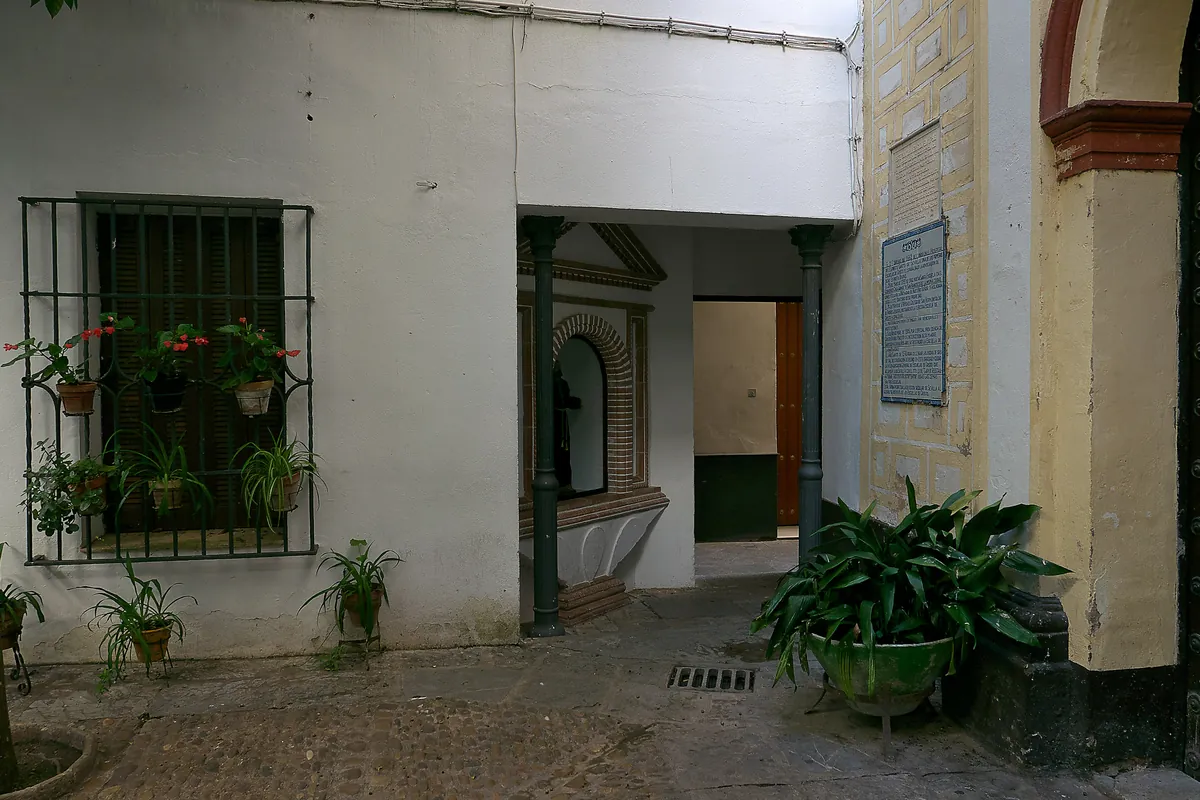
The medieval Jewish quarter of Seville lives on as Santa Cruz, a district Wikipedia now treats as the city's main place for visitors. Calle Mateos Gago, the Real Alcázar, the Jardines de Murillo and two streets named for Santa María la Blanca and San José mark its borders, and the cathedral with the Giralda lies inside. Flamenco Sevilla's page places La Casa de la Guitarra in an 18th-century house in the heart of that quarter, a few minutes from the cathedral and the Reales Alcázares. The street address is Calle Mesón del Moro 12, 41004 Seville.
The man behind it
Flamenco Sevilla's page says the cultural centre was founded by the flamenco guitarist José Luis Postigo. Spanish Wikipedia records two prizes he won in 1983: the Manolo de Huelva prize at the national flamenco contest in Córdoba, and the national guitar prize of the Cátedra de Flamencología in Jerez de la Frontera. It adds that he accompanied El Cabrero, Juanito Villar and El Lebrijano in the 1980s. Flamenco Sevilla's page says he studied flamenco dance for about ten years before he turned to the guitar.
The collection
Flamenco Sevilla's page describes an exhibition of flamenco guitars dating back to the 19th century and calls the house the first museum in the world of flamenco guitar and the home of one of the best guitar collections in the world. Those are the house's own claims. The show ticket includes access to the collection. Antonio de Torres, who worked in Seville in the 1850s and 1860s, is the maker from whose designs, Wikipedia says, most acoustic guitars today derive; the guide to Seville's guitar story tells his part.
Read next: Seville's guitar story
A twelfth-century arch
Flamenco Sevilla's page says that during the renovation of the house, workers found the original arch of the twelfth century that was once part of an Arab bath, and that the arch now forms the backdrop of the stage. This is the house's own account, and only a visit shows how it looks from the seats. It gives the room a layer older than the 18th-century house around it, which is one of the reasons Santa Cruz rewards a second look.
The plaque in the street
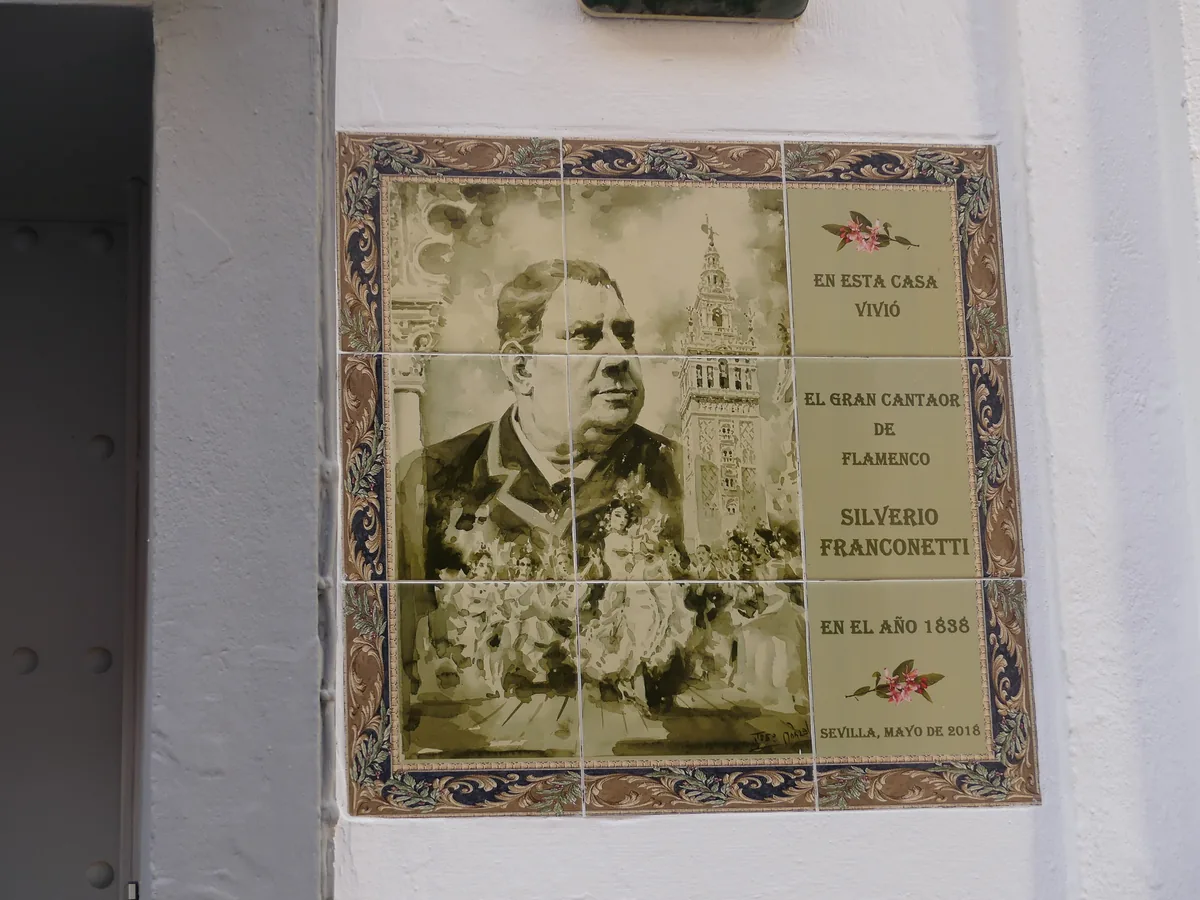
A tile plaque on Calle Mesón del Moro marks the house where the singer Silverio Franconetti lived in the 19th century; the Wikimedia Commons description puts it at number 12, the same number as the guitar house. Wikipedia calls Franconetti, who was born in Seville in 1831 and died in 1889, the leading figure of flamenco's Golden Age. An Expoflamenco article captions a childhood scene as Franconetti living on Calle Mesón del Moro with his mother and siblings, in 1839.
Seeing the collection on its own
The venue's own site gives the museum its own section, invites visitors to take a complete tour and presents the museum as open daily. Hours are best taken from that page on the day, since they can change. The show ticket on this site includes the collection; whether a separate visit is possible, and on what terms, is a question for the venue. Flamenco Sevilla's page puts the house a few minutes from the cathedral, so allow a few minutes on foot and a little extra to find the door.
Frequently asked questions
Who founded La Casa de la Guitarra?
The flamenco guitarist José Luis Postigo, according to Flamenco Sevilla's page on the house.
Where is the house?
At Calle Mesón del Moro 12, 41004 Seville, in the Santa Cruz quarter.
What does the collection contain?
Flamenco guitars dating back to the 19th century, according to Flamenco Sevilla's page.
Did Silverio Franconetti live in the house?
A tile plaque on Calle Mesón del Moro says he lived in the house; Wikimedia Commons places the plaque at number 12.
Sources
- Flamenco Sevilla's profile of the house
- The house's own website: show, museum, address
- Spanish Wikipedia entry for the guitarist José Luis Postigo
- Wikipedia entry for the Santa Cruz quarter of Seville
- Wikipedia entry for the guitar maker Antonio de Torres
- Wikipedia entry for the singer Silverio Franconetti
- Expoflamenco's archive article on Franconetti
- Commons file page for the Franconetti tile